On Friday, 28 November, the campus of the University of Information Technology and Management in Rzeszów came alive with energy and music during Afrofusion 2025 – an event dedicated to the cultures, languages, literature, and traditions of African countries.
The event gathered university students, local residents, and secondary school pupils from IX High School in Rzeszów, the School Complex No. 3 in Rzeszów, and I High School in Dębica. From the very first moments, the pupils were drawn into the vibrant atmosphere and actively took part in the programme prepared by members of the interdisciplinary Humanus Research Club, including students from Zimbabwe, Ghana, and Nigeria.
The International LitFest Harare Literature Festival
Afrofusion 2025 began with a discussion panel titled “Whose Word Counts? Exploring the Privilege of Articulation”, organised in cooperation with the LitFest Harare International Literature Festival, held on 26–29 November in Harare, Zimbabwe. The panel took place in a hybrid format: part of the audience and speakers were present in Harare, the Afrofusion team joined from Rzeszów, and panelists from Arizona State University connected from the United States.
The session perfectly reflected the interdisciplinary nature of Afrofusion, bringing together literary, legal, cultural, postcolonial, futuristic, and media perspectives. Thanks to simultaneous online transmission and live audiences across different continents, the panel became a genuinely international platform for exchanging ideas — focused on the question of who has the right to tell stories and why some voices remain excluded from global narratives.
The panel brought together respected scholars and creators from Southern Africa, the United States, and Europe:
- Dr Primrose Dzenga– award-winning poet and researcher at Arizona State University
- Dr Timiebi Aganaba– space law scholar and Assistant Professor at Arizona State University
- Dr Ignatius Mabasa– renowned Shona writer, oral literature researcher, Fulbright Scholar, and lecturer at the University of Zimbabwe
- Francis Matambirofa– panel moderator, Professor of Literature and Culture at the University of Zimbabwe
- Robert Muponde– writer and leading literary critic from Southern Africa, Professor at the University of the Witwatersrand
Dr Paula Wieczorek – researcher in literature, media, and culture, representing WSIiZ and host of the Afrofusion event
The panel centred on a concept developed by Dr Primrose Dzenga, who explained the Privilege of Articulation in a clear and accessible way. She emphasised that the concept concerns who in society has a real opportunity to speak, and why some voices are heard and taken seriously while others are pushed aside. She underlined that the key issue is not merely the ability to speak, but whether one’s words are recognised as credible, important, and worthy of attention.
She pointed out that when certain groups lack the space to share their stories, the world sees only a fragment — often incomplete, distorted, or harmful. The panelists agreed that this mechanism operates not only in healthcare, but also in education, politics, media, and culture. They stressed the importance of ensuring that more diverse voices appear in public debate, as only then can we build a fuller and more honest understanding of the world.
In her own talk, Dr Paula Wieczorek explained that the Privilege of Articulation helps us understand who shapes global discussions — and whose voices remain unheard — both in media and in pop culture. She noted that for decades, global narratives, including those about the future, have been shaped mainly by Western mainstream productions such as Star Wars, which present visions of space, technology, and future societies from a single dominant perspective.
She also highlighted that a similar mechanism operates in climate-related communication: global perceptions of the causes and consequences of climate change are often shaped by those with the strongest media influence — not necessarily those who experience the crisis firsthand, and sometimes not even scientists. As a result, viral content and simplified messages often overshadow expertise and lived experience. This dynamic, she argued, makes the voices of communities most affected by climate change less audible in the global conversation.
Dr Wieczorek also pointed to films and narratives created outside the dominant mainstream — such as Black Panther — which break these patterns by showing that the future can be imagined differently: through multiple perspectives, alternative value systems, and with space for voices that have long been marginalised. In doing so, they change not only how we imagine the future, but also who we allow to shape it.
For the participants, the panel was a unique opportunity to witness international scholarly debate and see how interdisciplinary approaches help us understand issues of representation on a global scale.
“What happened during the panel perfectly reflects the mission of Afrofusion — bringing together perspectives, disciplines, and cultures in a dialogue that truly matters for today’s global challenges,” summarised Dr Paula Wieczorek.
Music, Dance, and Culture
After the academic portion, the event shifted into interactive activities that generated tremendous enthusiasm among the pupils. WSIiZ students prepared a series of quizzes through which participants not only had fun but also learned new and surprising facts about Africa.
“We wanted to show Africa as we know it — full of colours, diversity, and stories people don’t always hear about,” explained Isaac Mhaka, who led the quiz on geography, symbols, and tourist attractions.
Donald Matsheza’s quiz “Zimbabwe vs South Africa” was received with equal excitement, allowing participants to compare the history, culture, and daily life of the two countries.
“Breaking stereotypes and having fun together was the most important thing — and the pupils’ reactions showed that we achieved exactly that,” he concluded.
Later, Leonel Mugano guided the audience through a musical journey into Afrobeats, while Ransford Asare tested their knowledge of contemporary Ghanaian artists. Laughter, friendly competition, and spontaneous reactions filled the room, with pupils growing more confident with every round and naturally overcoming linguistic and cultural barriers.
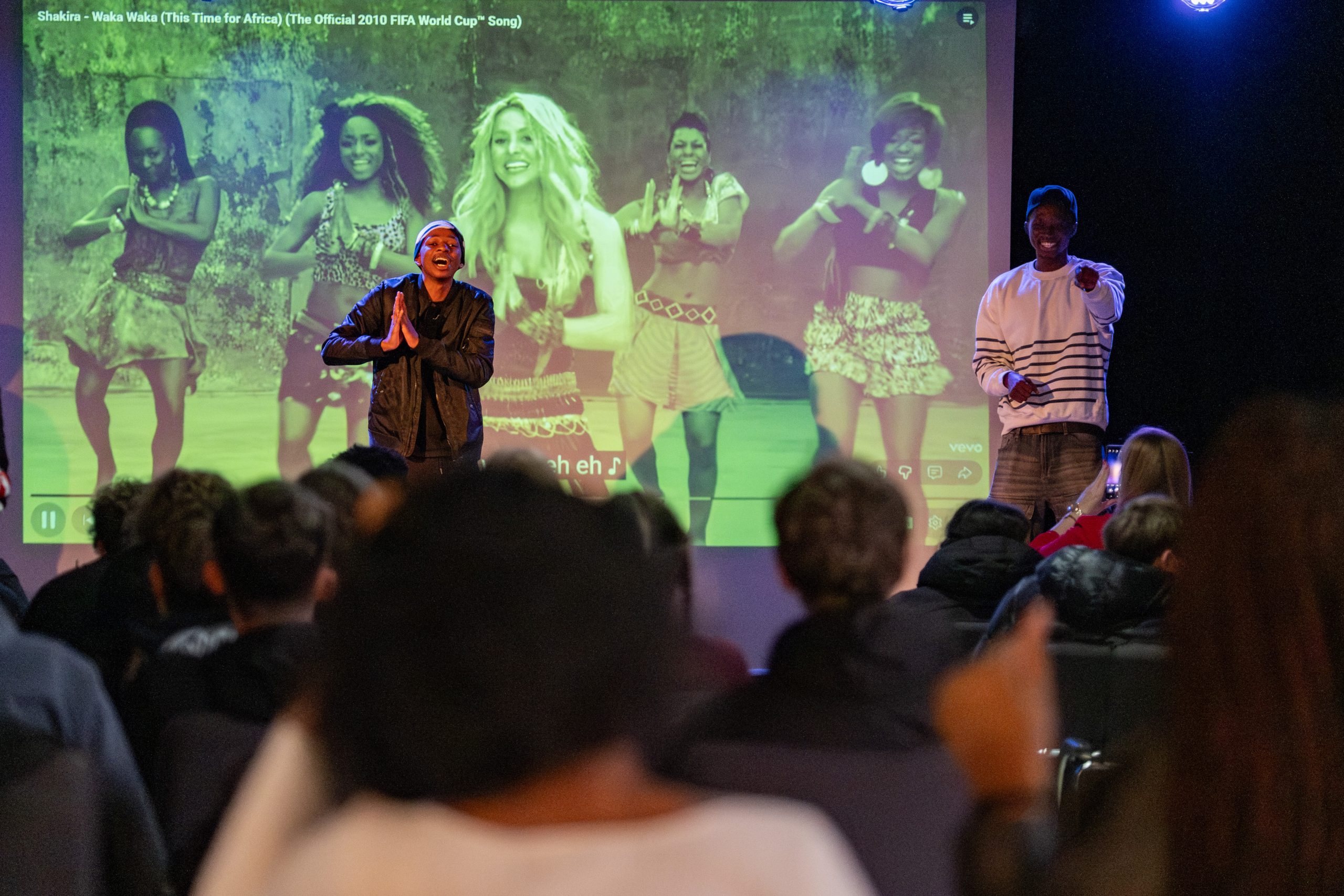
Before noon, the atmosphere reached a joyful peak when students led a short dance session to Afrobeats rhythms and the iconic “Waka Waka.” Pupils eagerly joined in, and the IQ club space transformed into a lively dance floor.
“It’s incredible how quickly music can connect people who are meeting for the first time,” one of the pupils observed.
Languages, Cuisine, and Traditions
In the final part of the event, students delivered short presentations that introduced pupils to the richness of African cultures.
Vongai Petros spoke about the continent’s remarkable linguistic diversity and explained how language shapes identity and ways of understanding the world.
Esther Chidyandunge guided participants through African culinary traditions, describing how many dishes carry symbolic meaning and reflect shared history and everyday life.
WSIiZ alumna Tariro Jonga concluded the session with a presentation on cultural customs and rituals, highlighting the importance of oral storytelling, rites of passage, and communal practices that bind societies together.
The Mission of Afrofusion
Afrofusion 2025 created a space where stereotypes were naturally broken, global cultural competence was developed, and participants learned curiosity and respect for diversity — while also practising English in a real intercultural context. Every part of the event — from the panel in Harare, through the quizzes and dance sessions, to the stories about African languages, traditions, and cuisines — demonstrated that music, movement, and storytelling are universal languages that bring people together faster and more effectively than words alone.
The organisers emphasise that such initiatives build a truly open and socially engaged academic environment. Afrofusion 2025 not only shared knowledge about Africa but, above all, created a space for collaboration, mutual understanding, and meaningful intercultural exchange. Thanks to the energy of the students, the enthusiasm of the pupils, and the international cooperation with scholars and artists from Zimbabwe, participants experienced firsthand how cultural diversity enriches dialogue and broadens perspectives.